
NBA Project
This project is an end-to-end data platform delivering insights and predictions for the NBA season via a custom-built interactive dashboard. The system is fully containerized and deployed on AWS using best practices, including CI/CD pipelines, Terraform-managed infrastructure, and automated testing.
User-Facing Services
Section titled “User-Facing Services”Core Components
Section titled “Core Components”- Ingestion Script – Scrapes, loads, and stores raw NBA data.
- dbt Project – Cleans, transforms, and models data.
- ML Pipeline – Generates daily win probability predictions.
- Terraform – Manages infrastructure as code.
Operational costs are minimal (around $1/month), primarily by leveraging the AWS Free Tier and other third-party cloud services.
Architecture Diagram
Section titled “Architecture Diagram”System Components
Section titled “System Components”1. Data Ingestion
Section titled “1. Data Ingestion”- Python Script using Pandas, SQLAlchemy, and various other packages to gather data from a series of sources
- Data is ingested into the Bronze Layer of a cloud-hosted Postgres Database, and also backed up to S3 for redundancy
- Utilizes a feature flag table to determine what data to pull on each run
- Ran via ECS Fargate as part of the daily pipeline orchestrated with AWS Step Functions
Note: The NBA blocks AWS IPs from accessing their API, necessitating custom scraping solutions.
2. dbt Transformations
Section titled “2. dbt Transformations”- Transforms raw Bronze data through a medallion architecture (Bronze -> Silver -> Gold)
- Silver Layer: Fact and dimension tables standardize column names, enforce data types, and perform light cleaning; intermediate tables build custom models for downstream services and enable early data quality validation
- Gold Layer: Analytics-ready marts optimized for consumption by the REST API and Frontend Dashboard
- Utilizes dbt-expectations for comprehensive data quality testing
- Intermediate tables in the Silver layer isolate and validate transformed models early, preventing data quality issues from propagating to the Gold layer and downstream services
- Ran via ECS Fargate as part of the daily pipeline orchestrated with AWS Step Functions
Raw Sources] --> B[Fact Tables] A --> C[Dimension Tables] subgraph Silver[Silver Layer] B C D[Intermediate Tables] E[ML Features] end B --> D C --> D B --> E C --> E D --> F[Gold Layer
Analytics Marts] E --> F style A fill:#cd7f32,stroke:#8b5a2b,stroke-width:1.5px,color:#fff style Silver fill:#d1d5db,stroke:#6b7280,stroke-width:2px,color:#333 style F fill:#ffd700,stroke:#b8860b,stroke-width:1.5px,color:#333
3. ML Pipeline
Section titled “3. ML Pipeline”- Python Script which pulls purpose-built ML feature datasets from the Silver Layer and generates win probability predictions for upcoming games using a Logistic Regression model
- Model features include recent team performance, rest days, and active injuries for both teams
- Predictions are written back to the Gold Layer in Postgres and served by the REST API & Frontend Dashboard
- Ran via ECS Fargate as part of the daily pipeline orchestrated with AWS Step Functions
4. REST API
Section titled “4. REST API”- Python Application which pulls transformed & enriched data from the Gold Layer in Postgres and serves it over public HTTP endpoints
- Includes a lightweight web app for users sign in and make betting predictions for upcoming games
- Also includes Admin pages for managing various aspects of the project, like feature flags
- Deployed as a serverless application (AWS Lambda) for $0 / month.
- Utilizes CloudFront & Route 53 for distribution and routing to https://api.jyablonski.dev.
Query Example
Section titled “Query Example”curl -H "Accept: application/json" https://api.jyablonski.dev/v1/league/game_types5. Frontend Dashboard (Dash)
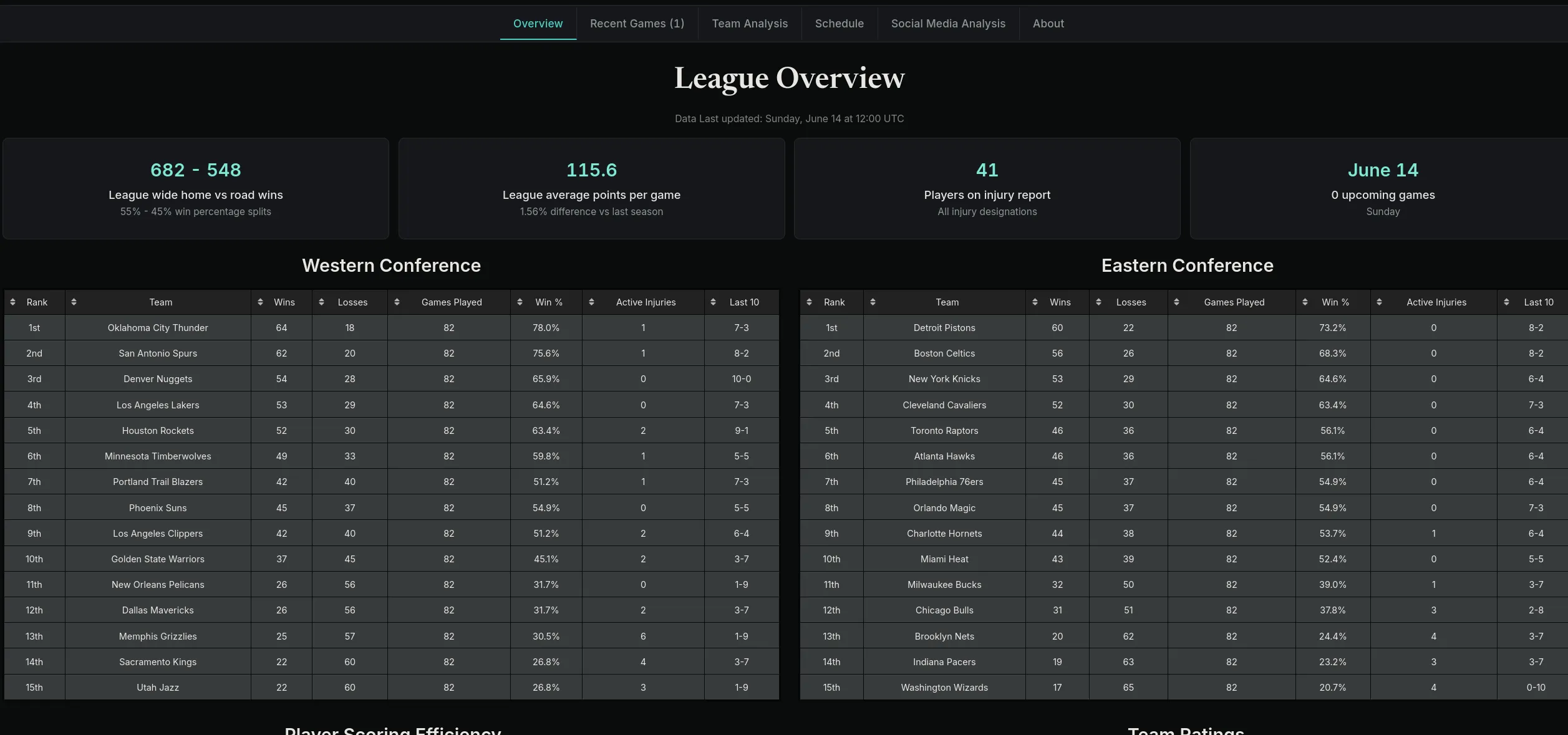
Section titled “5. Frontend Dashboard (Dash)”- Python Application built with Dash which pulls data from Postgres to serve various tables, metrics, and graphs
- Fully interactive with filtering and drill-down capabilities.
- Hosted on free-tier resources and routed via Route 53 to https://nbadashboard.jyablonski.dev.
Infrastructure
Section titled “Infrastructure”Terraform
Section titled “Terraform”-
Entire AWS stack provisioned via Terraform using custom-built modules for:
- S3 Buckets
- IAM Roles
- ECS Tasks & Services
- Lambda Functions
- PostgreSQL Infrastructure
Common Modules
Section titled “Common Modules”Custom internal Python package jyablonski_common_modules used by various services for:
- AWS utilities (S3, Secrets Manager helpers)
- Standardized logging
- Postgres connection management & upsert functions
Ensures DRY principles and code consistency across services.
Orchestration (Step Functions)
Section titled “Orchestration (Step Functions)”- AWS Step Functions orchestrates the daily pipeline (Ingestion -> dbt -> ML) for $ 0 / month
- It triggers each Task to run in ECS Fargate in a free-tier VM
- Apache Airflow would be preferred, but opted for Step Functions due to cost efficiency
Database Management
Section titled “Database Management”- Postgres serves as the core database
- All schemas, users, roles, and permissions managed via Terraform
- Least privilege principles are implemented with strict role-based access control
module "reporting_schema" {  source = "./modules/postgresql/schema"
  schema_name   = "reporting"  database_name = var.jacobs_rds_db  schema_owner  = var.postgres_username
  read_access_roles  = [module.rest_api_role_prod.role_name, module.dash_role_prod.role_name]  write_access_roles = [module.dbt_role_prod.role_name]  admin_access_roles = [var.postgres_username]}
Although it’s an OLTP Database and not a true data warehouse, it effectively handles the analytical workloads for the project while being the most cost-effective solution available.